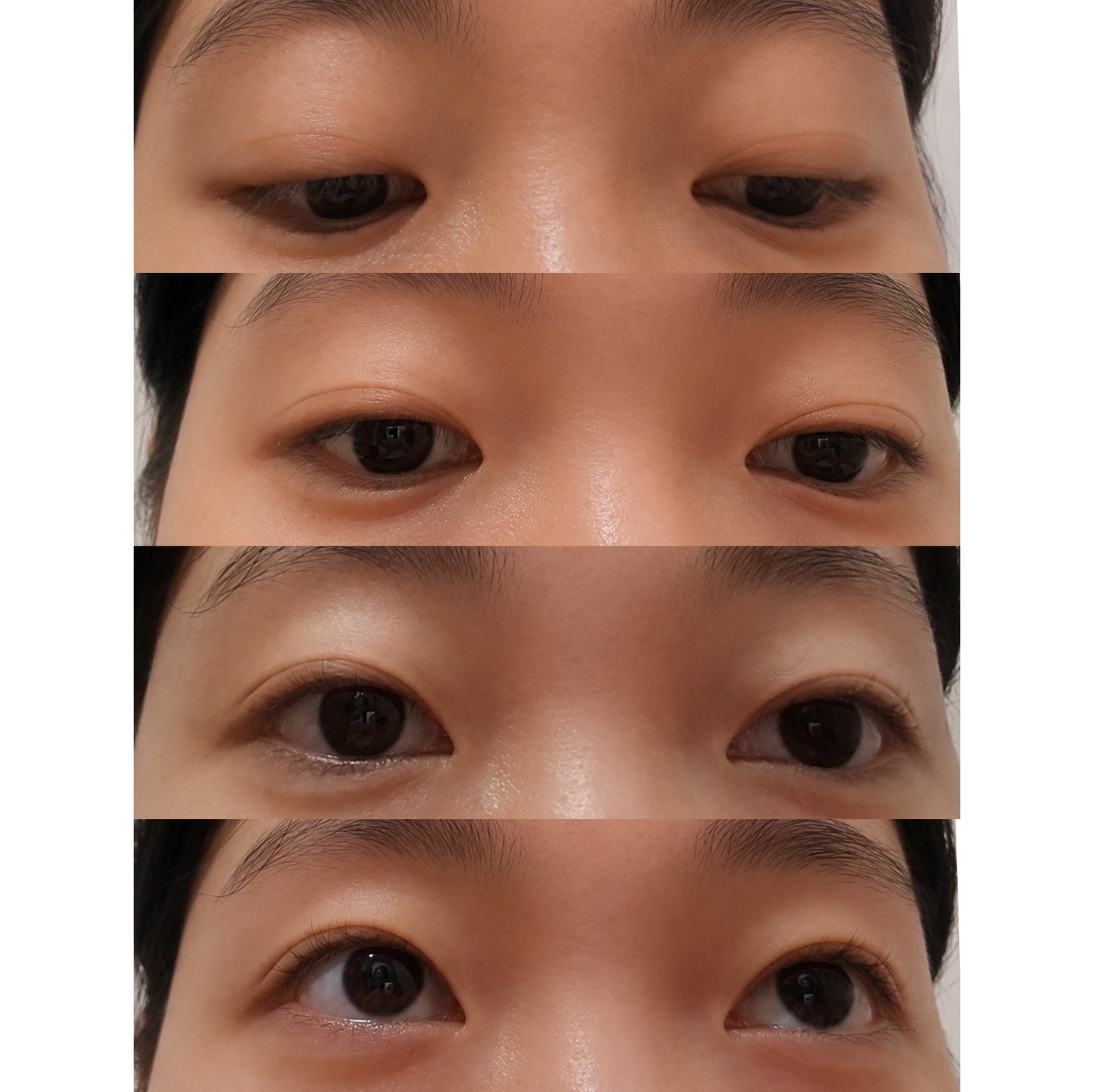
Optifold is a two-part nighttime double eyelid tape system worn overnight and removed in the morning. Its EyelidShaping™ routine is designed for people seeking a more consistent eyelid crease without wearing visible tape during the day.
How the system works
The F-tape lifts and sets the eyelid crease while you sleep.
The N-tape compresses the crease and supports the fold so the eyelid can hold the shape more consistently.
Wear nightly, with progress building gradually over time.
Designed for monolids, hooded eyelids, uneven eyelids, and unstable eyelid creases.
Made with medical-grade 3M adhesive: latex-free and designed for safe overnight skin contact.
Customer Reviews
Overall rating: 4.3 / 5 from 49 reviews.
ngl optifold actually worked so well for me 😭
it took me a bit to get the application down, but you just have to figure out what works for your eyelid shape. biggest tip ACTUALLY follow the instructions!! skipping even one tiny step makes a huge difference. once i did it right, it worked lik a charm!
my crease has been staying in place on its own every morning for about 2 months now so i don't even need the tape anymore. plus my eyes used to look so tired and hollowed out before now they look so much fuller even, and full of life! super happy with it!!
Actually worked. I was pondering about getting eyelid surgery for years and i was using the day tapes since I was a teen, then found optifold. Decided to give it a try since they're way cheaper than blepharoplasty, took some time getting used to, thanks to the team for helping guide me through, very happy with my double eyelids!!
Progress was a little slow in the beginning, but I'm getting more used to using the tapes. I only have a few tapes left, and my eyelid is definetly in a different stage from before, but I honestly thought progress would've been faster.
wow, this thing actually works. i’ve never seen my left eyelid crease change so easily like this before. it’s sorta too early to say this is permanant for me, but it’s only been 3 weeks since i started and the last few days i didn’t even use tapes at night.
Store owner replied:
Thanks for the honest 3-week update, Mai1997 Q. You’re right that it’s early, but tape-free nights are a really good sign. If you want, email us a quick eyelid profile clip and we’ll help you tighten the placement so it stays consistent.
ok, i get it now what people are saying that it takes time to do this, but honestly, it's totally worth it especially since there is no other way to do something like this, and on top of that, i don't really have the money for surgery. but this is literally like a miracle product. I'd say the biggest thing following instructions because there are a lot of them, but they are not that hard to learn, it's just making time for it. Love me new eyelid crease and can now rock this cool look without tapes or glue. oh yeah, it took me about 7 months to get reliable results, but i already knew my eyelid was adapting by month 1.
Bought like 5 times after being told my eyelids would form (after sending videos) and never worked. Probably ruined my natural eyelids if anything. Will be getting surgery next year
Store owner replied:
Hi Alice — we recognize this case and want to clarify a few important points for anyone reading.
You did purchase multiple times after we confirmed you were structurally a suitable candidate based on your eyelid profile videos. However, qualification does not mean results will happen automatically — Optifold is a technique-dependent system, not a passive product.
In your case, we did not receive any follow-up:
- No tape application videos
- No removal/crease retention feedback
- No questions about sizing, placement, or daily habits
Without that feedback loop, we cannot calibrate:
- Tape positioning
- Tape size selection
- Eyelid crease exercises
- Daily behaviors that affect crease stability
This means the outcome reflects an uncalibrated self-guided routine, not the Optifold system as it’s designed to be used.
We’ve actually addressed this exact situation in detail here:
👉 https://www.tiktok.com/@optifold/video/7570431317075119380
For anyone considering Optifold — results come from:
correct application + iteration + feedback + habit alignment
When those are followed, users consistently see progression. When they’re not, outcomes become unpredictable — regardless of how many times the product is purchased.
If you ever decide to revisit this properly with guidance, our team is here to help.
Omg lol it actually works!! Super happy with my results and don’t need to pay 5k on surgery!
They’re incredibly uncomfortable and its annoying to have to trim them everytime because theyre too latge for the crease i want to make. I dont think this pack is worth +$100.
Store owner replied:
Hi Cynthia — thank you for sharing your experience. We want to clarify a few important points for context.
What you described as “uncomfortable” is actually the intended skin interaction that allows the crease to form. Products that feel like nothing typically do not generate any structural change, while excessive force can cause irritation. Optifold is designed to sit in that controlled middle where the skin is being actively guided, not passively covered.
Regarding trimming, this is a customization feature, not a flaw. Eyelid shapes vary significantly, and being able to trim the tape allows users to match their exact crease target, adjust for smaller or more precise eyelid structures, and avoid the limitations of fixed-size tapes that cannot be modified.
Results with Optifold depend heavily on correct tape size selection, placement, and gradual adjustment based on feedback. We did not receive any follow-up from you regarding fit or technique, which is where we typically help users refine comfort and improve their experience quickly.
On pricing, Optifold is not positioned as a basic cosmetic tape, but as a calibrated system designed for long-term crease formation, which is fundamentally different from temporary-use products.
If you’re open to revisiting this with proper sizing and guidance, we’d be happy to help you get a much better experience.
Tried it early this year. I can see it working, but it does take some extra time and attention which I don't have. Seeing how many people got results , I'll probably try again soon.
Store owner replied:
Hi Bau,
Thanks so much for sharing your honest experience! You're absolutely right—Optifold does take a bit of time and consistency, especially in the beginning. But once that routine clicks, the results can be incredibly rewarding (as you've seen from others too!).
If you do decide to try again, feel free to reach out to us. We’d love to give you a few shortcuts and tips tailored to your eyelid profile to make the process easier and more efficient for your lifestyle.
Looking forward to helping you get the crease you’re aiming for! 😊
— Yuna @ Optifold Customer Support Team
Store owner replied:
Hi Rashaad — we want to clarify this for anyone reading.
Our refund policy is clearly stated on our site here: https://opti-fold.com/en-ca/pages/refund-policy
Tape packs are classified as consumable-use items, which is why all tape pack sales are final and not eligible for refunds. This is standard for products that come into direct contact with skin and cannot be resold or reused once purchased.
That said, we always encourage customers to contact us before assuming anything. In many cases, concerns can be resolved through guidance, sizing adjustments, or application support rather than a refund request.
We’re always available to help — but it’s important that the policy is understood upfront so expectations are clear.
Okay, so I don’t usually leave reviews, but I had to say something because Optifold actually works — if you use it right. At first, I didn’t get it. I thought it was just another gimmick, but then I watched the tape application videos properly and realized I was doing it wrong.
You really need to pay attention to the videos and follow the instructions exactly — where to place the tape, how to stretch the skin, how to wear it overnight, all of that matters if you want a clean, even crease. The first couple of nights I messed up the placement, and my results were kinda meh. But once I got it right, I started seeing a real difference.
If you’re thinking of giving up early — don’t. Be patient, take the time to understand how to apply it, and you’ll get those clean results. My crease is way more defined now, and it actually looks natural. Super happy!
“No Sagging, and the Results Stayed!”
I honestly wasn’t expecting this to work as well as it did. I used the tapes consistently for a few months, and not only did I see results — they actually stayed. I haven’t had any eyelid sagging or drooping since, and it’s been a huge confidence boost.
What I really appreciated was how detailed and helpful the support was. They took the time to explain why the tapes work and how to use them for longer-lasting changes, which made all the difference.
If you’re thinking about getting permanent double eyelids without surgery, this is it. It takes commitment, but it’s 100% worth it — especially when the results are real and lasting.
So before I started this thing, I was desperate. I. Needed. Double. Eyelids. My mono-lids caused my eyes to get tired really easily and it hurt whenever i tried to look up because the lids would push against my eye. So then, I was searching online for methods to get double eyelids without surgery because 1) I'm scared of knives/surgery and 2) my family was against it. Soon, I found Opti-fold and I decided to try it out. I ordered and shortly after, the administrator got all the information about my eye in order to make suitable tapes. I got the tapes a couple days later and wow the results were faster than expected. It took only about a week for the crease to sustain for the whole entire day. I have Asian eyelids and i was really obsessed with wanting natural eye crease. But the Opti-fold person advised me to put the tapes where my eyelids themselves could naturally fold. That was a big factor to me having long lasting eye crease. Thank you, Opti-fold.
I've always been extremely self conscious about my uneven eyelids. I was already quite a chubby kid and having an extremely unsymmetrical face just made me feel so much uglier. I used to cry at night wishing that I could have plastic surgery and fix my face.
One night in 2016, freshman year of college, I was randomly googling solution to my uneven eyes and I came across Optifold as a search result. Optifold was still quite new and there were not too many reviews yet, but the tape's technology stood out to me amongst all the other tapes I have used before. Other tapes have stretched my skin out and made my eyes saggier, whereas when I finally tried Optifold's tape, for the first time ever, my eyelid was actually behaving! It was so cool seeing my fold migrate to a more flattering part of my eyes! My mom and I were both so happy since we were able to save thousands of dollars from eyelid surgery!
My new eyelids have since lasted for years now and have even returned after nights of sobbing and its inevitable swollen eyes. Even when I rub my eyes with no restraint, my eyelids have managed to stay with me! Optifold has help me become so much more confident and helped me embrace my natural beauty!
I started using opti-fold hmh 5 months ago! At the beginning it was kind of weird since I wasn't used to the whole process of applying the tapes in the correct order/removing them and also well sleeping with them, but in less than 4 days I got used to it so no problem!
About results. I started seeing results after 1 month of use, the eyelids would hover around 85% to 95% perfection in my opinion. The second month they were definitely getting better! So, in less than 1/2 months I was already seeing lots of progress and I'm pretty sure it could have been faster if I actually positioned the tapes in the perfect way like I do now.
Fast forward to today, normally my eyelids are super fine, though there's 1 day or 2 that sometimes they decide to be uneven, but when that happens I just use the tape in that day and then everything is okay. (Or I can be a lazy and just let the eye be, and normally next day it's already fine) So I'm pretty happy about the results!
About the organization, the owner of Opti-fold is an amazing person, always driven to help the customers and very helpful/kind. I wish nothing but success for this project that Actually works in such simple ways as a little tape in the eyelid.
Store owner replied:
Hi Mei Hui,
Thank you for your feedback! We understand how frustrating it can be when only one eyelid needs adjustment but the tapes are sold as a set. Since double eyelids can shift over time, most of our clients find it useful to have both sides available for long-term balance.
That said, we’re always open to improving our offerings! Your input helps us refine what we provide, and we’ll keep this in mind for future updates. 💡
Thanks for being part of the Optifold community! If you have any other suggestions, feel free to share. 😊
Best,
Yuna
Optifold Customer Service
I only have Double eyelid on my right eye. I used to have double eyelid on both eyes. But suddenly left eye has another line. It makes my original eyelid wrong. So I had two lines or no line on my left eye.
That's why I had used eyelid tape for few months and it was not that good. I couldn't put much shadow on my eyes. Sometimes the tape ruins my eye make up.
While I was having trouble, I found out opti-fold tape. At first time, I didn't sure about this tape. But after taking with Ray, I just decided to trust Ray.
The result is unbelievable. I just put two tape before I sleep. That's only what I did. The next day, I got double eyelid right away. I couldn't believe the result. But it's true. After 6 months, I got permanent double eye lid on left eye.
It's miracle. Everyday I'm happy to wear make-up and happy to see my eyes. Also I'm really thanks to Ray!!! And I want to share my happiness with others who has an eyelid problem.
I have used this product for approximately 11 months, and I have almost achieved permanent results. I wear the product about once a week now. I experience slight regression with poor sleep or study but overall, my eyelid is much better than it was - oh, and I’m Caucasian treating uneven eyelids, I’m not going from mono to double lids :)
What can I say....I was looking for something to give me double eyelids. I looked for hours, and somehow stumbled upon this Opti-fold. Decided to research more, and ended up buying it. The results were fantastic, it took a little bit for me to learn how to put them on correctly but it's worth it.
- Adhesive lacks sufficient strength
- Not suitable for use in humid conditions
- Not effective on eyelids that require moisturizing with lotion beforehand
- Challenging to remove tape from packaging without compromising adhesive quality
- Only needed for one eyelid; a single-eye purchase option would be a convenient alternative
- Overall, it effectively keeps my eyelid folded, but there are several challenges in maintaining consistent use
Store owner replied:
Hi Kimberly,
Thank you for your thoughtful and detailed review. We really appreciate you taking the time to highlight both the benefits and the challenges you experienced—it helps us and others understand what to expect.
A few points we’d love to address:
– Humidity & Moisturizing: You’re absolutely right—humidity and pre-applied lotions can interfere with the adhesive. We usually recommend applying Optifold tapes to clean, dry skin for best results. Some clients have had success with oil-free toners or gentle primers to help the skin prep better.
– Adhesive Sensitivity & Packaging: We’re currently reviewing how the tapes are pre-cut and packaged to minimize the chance of compromising the adhesive during removal. Your feedback here is especially helpful.
– Single-Eye Use: This has been a popular request, but at the moment, we don’t offer single-eye packs due to the way the product is manufactured and tested for balance across both eyes. That said, many clients keep the unused side for backup or share with someone they trust.
We’re glad to hear the tapes are effectively keeping your eyelid folded—and if you’d like, we can help troubleshoot some of the challenges to make consistent use easier. Just reach out and we’d be happy to assist!
— Yuna @ Optifold Customer Support Team
Can’t live without these tapes! I’ve been using it for over a year and it’s all I’ve ever wanted - an overnight solution that balances out my eyelids crease the entire day. I’ve always had unbalanced eyelids - my left eye has a tapered eyelid while my right is a puffy monolid. It took me a few months to get the hang of using these tapes to form my eyelids because if placed incorrectly, the double eyelid wouldn’t form which can be frustrating. But I will encourage you to have patience, keep trying and follow the Optifold guide! I make sure to keep looking up after i remove my tape on the morning. It is very important not to spend the first few hours of the day looking down at your phone or laptop, especially when commuting. When i do that, i find that my eyelids wouldn’t hold the whole day. Also, the biggest tip I have for beginners is to take photos of your eyelid tape placement every night so you know what worked and what didn’t.
The only downside of this is that it’s not a permanent solution for me. My eyelid turns back into a monolid if I don’t use the tapes for more than 2 days so I’ll have to keep purchasing it. I was hoping it would be permanent considering I’ve used this for over a year. It is a bit pricey but overall I think it’s worth it for my eyelids.
one of my eyelids has come to be a bit weaker than the other one and has a triple lid. it's very inconsistent and the feeling of it flipping would bother me throughout the day. I've considered surgery but with these tapes I've been pretty happy with the progress and no longer think it's needed!
I've been using this for about 4 months now (currently going through my second order)
It took a little while to figure out what works best for my eyelids - they don't seem to hold if the tape is the full size. I trim down to the thinnest + trim a bit off the bottom (straight across right below the bottom of the letter and numbers).
They still don't last a whole day (especially depending on how hydrated I am), and the creases can hold for as little as a couple hours. I started applying a small bit of eyelid glue right on the crease the tapes leave and that gives me confidence in lasting the whole day
I had excellent results using Opti-fold Cosmetics. It is a natural solution which is solving my uneven eyelids without surgery. I have uneven occidental eyelids (single eyelid and a normal eye).
I’ve always had a very thin crease on one of my eyes when I was young. I wanted a thicker and more defined creases on both of my eyes, so I started using the generic eyelid glue and tapes I found at cosmetic stores. While the glue and tape helped me create the new thicker creases, they were not defined at all and went away after I remove the glue/tape for the day. I became frustrated with my unstable creases and almost gave up. Out of desperation, I started looking for any methods that are non-surgical and non-invasive online. Luckily, I came across Opti-fold. I began the Opti-fold journey about one month and a half ago and I could not have been any satisfied and happy with the result. My left crease became stable about a month into the program and I have not had the need to apply the tape on my left eyelid since then. Although my right crease is still unstable, Ray has been very helpful with giving me advice and tips on how to stabilize my right crease. I began this journey fully understanding that the creases will not appear in one day. It takes time and persistence to make it happen. I am so happy with the current result and I am definitely more satisfied with my new look. I cannot wait for my right crease to finally become stable!
I just really want to thank you guys for changing my life. My eyelid is now back to normal, I don't depend on eyelid tapes anymore. I used to be depressed in regards to my uneven eyelids. It resulted from eczema scratching. I was self conscious and it looked weird. I went to a dermatologist and I showed them my uneven eyelid, they said I had no hope but to get surgery to fix it. I found this on youtube, and tried it. The best decision i've ever made.
You were so responsive in helping me in regards to my lack of confidence in the product but I kept pushing through. The customer service was 12/10, and you were so detailed in telling me how to cut the tapes. I can't thank you enough.
Thank you so much, you changed my life. I highly appreciate it. I told my cousin about this product and he has purchased it for $75 I believe.
YOU ARE THE BEST! Thank you! If I didn't believe in myself that there were other alternatives other than surgery and listened to the dermatologist, I would've stayed a self conscious person if I wasn't led to this eyelid tape.
YOU ARE A GENIUS!
One year ago, my right Asian eyelid crease disappeared and my eyelid drooped giving me a tired look. In the past this happened maybe 2 times a year but it started to become common for the past year. I tried sleeping more and changing my diet but nothing seemed to be working. I tried searching endlessly on the web about droopy eyelid and still NOTHING helped. Finally an eyelid specialist told me about my droopy eyelid problem and told me that I had permanently lost my crease. This specialist also told me that the only way to fix it was through surgery. However, I didn't want to believe surgery was my only option so I researched ways to fix my droopy eyelid and came across Opti-fold. I watched numerous Opti-fold videos and liked what I saw so I decided to give it a try. The first time putting on the tape was confusing but Ray the owner assisted me all the way until I got it on perfectly. After putting on the Opti-fold tape for one night, my right droopy eyelid became double again and the crease formed. After putting on Opti-fold for a few more nights straight, my crease and double eyelid lasted for a few days (I didn't test to see how many days it would last without drooping again). This was one of the best investments I've ever made and I definitely will be purchasing more. Thank you Ray!!!
The tapes really helped me! I have double eyelid on one side and have always been self conscious about my uneven eyelids. It took only about a month of using it every night for me to see results. I only wear them at night and for the rest of the day my eyes are even. I’ve tried double eyelid tape before but they have never given me long lasting results. Ray was very knowledgeable and quick to respond to every inquiry I had. I didn’t realize I was putting the tape wrong and he managed to show me a better way and that make my results even better.
I've had uneven eyelids my whole life, and it created a lot of insecurity issues with my appearance. I would always pay extra attention to how uneven my face looked in photos, which took a toll on my confidence.
With Ray's amazing product, my insecurities were fixed, and my eyelids became even after repetitive wear of his product. Not only that, Optifold was MUCH cheaper and much less abrasive than surgery would have been.
Ray's tapes are much stronger than conventional eyelid tapes, and they are suited for your specific eye shape (they all come in different sizes, so everyone has tapes for them). In general, Ray is quite flexible with his communication (I live in China), which made the process much easier and allowed me to get the most effective results. He would also correct me on my application of the tapes and would encourage me as my results grew more prominent.
Even though I'm only a seventeen-year-old girl, my life has changed so much with his product. Although looks aren't everything, my even eyelids made a big difference in my day-to-day life. Makeup application is easier (especially eyeliner), I don't worry constantly anymore, and I am much happier. Friends and family have also complimented the symmetry in my eyes.
Overall, I recommend the Optifold with all my heart, especially if you are scared of surgery. His product is a bit slower than surgery, but it IS permanent (mine took 5 months). If you have any questions with the product itself, Ray is receptive 100% of the time and always responds in a timely manner, so don't hesitate to ask anything!
I am using this product. This product is so amazing. I have used about 1 year. And this made my double eyelids. Before I met this product, my eyelids were so weak and sometimes it appeared and sometimes disappeared. At first, I wonder how it could work. But I don't want to get plastic surgery. So, I tried this product. And 6~7 months later my eyelids appeared all day. I guess the reason I got late result is that I couldn't put the tape appropriately. I think the most important thing is putting the tape on the same spot everyday and also wipe oily skin before putting the tape. Now, it lasts 2days without tape. So, I will try this product until I get permanent result. Thanks Ray! (sorry for poor English)
Always thought it was hopeless for me to get double eyelids but gosh this thing really works after I put it on for 3 months, getting a new batch for my left and more stubborn eye, thanks Ray :D
I had uneven eyelids for years (woke up with one double eyelid one day) and wanted a permanent solution to even them out. I was initially hesitant to try Opti-fold but after detailed consultation with the Opti-fold team, I decided to give it a go! 6 months later I have permanent double eyelids! Key is to apply the tapes daily and to be patient. I started to see results 1-2 months applying the tapes. Also do the eyelid exercises diligently in the morning when you wake up. Also, the Opti-fold team were always very helpful and gave tips on creating the double eyelids. If you’re hesitant, definitely give it a go. I am very happy with my results :)
I have single eyelids, but for the past year or so I would wake up with double eyelids, usually on just one eye, that would disappear after a short while. Wanting it to be more consistent without the invasive surgery, I started googling and stumbled upon Opti-fold.
The owner of Opti-fold, Ray, and I started e-mailing back and forth, and he has been super helpful and has followed me up very closely with great guidance and helpful tips.
When using Opti-fold, perseverance is key! It takes a couple of weeks for the eyelids to become stable, and even then I often lose the double eyelids by the end of the day. Sometimes it can be discouraging when the double eyelids last way shorter than they did the day before, but just keep using the tapes. You have to experiment with the placement, and figure out what works for you. Ray is of course very supportive with this.
In the end, though, you will be able to see that the double eyelids are becoming more and more stable, slowly but surely. I've gotten great compliments and I feel greater about myself than ever. Although I still have not reached the permanent stage yet, I am still determined to continue using Opti-fold, thanks to the effective, non-invasive methods, and the great support that Ray has given me.
I have occidental eyelids and my left eye lid has been significantly higher than the other one all my life. I had been using generic eyelid tape for a year with no results before I managed to find Opti-fold. I was skeptical at first but I'm so glad I bought it. I started using it just over 2 months ago and the problem is beginning to fix itself. In a few months time it looks as though it will be permanently fixed.
I originally had double eyelids but due to stress, allergies, and constantly rubbing my right eye, I developed a so-called "triple eyelid". This condition usually lasted at most several weeks and my eyelid would return back to normal however, this time it lasted more than six months and had me seriously worried if this was going to be permanent.
I had tried searching for solutions online and people only suggested unhelpful remedies like sleeping earlier or using eyelid tape. I tried using normal tape before by cutting it into a moon shaped piece, but that did not work. I was particularly afraid the normal tape would stretch my eyelid and make it sag.
After researching, I felt assured that Opti-fold's methods and tape would not stretch my eyelid skin. When I first used it, the application process took long as I wanted to get every step right. For the first day, my eyelid crease looked great. It looked like my original double eyelid. For the first week the longest the crease would stay was about a day before it returned back to a triple eyelid. Sometimes I would have trouble applying the n-tapes but after getting some advice and having more practice each day, I started to get the hang of it. My eyelid crease also maintained for around 2 days now. After my first month of using the tapes I tried going without the tapes for a few days. To my delight, my eyelid crease stayed for those few days. Up till now my eyelid crease has returned to its normal state for nearly 2 weeks now.
The feeling of not having to worry about going out and be conscious of my uneven eyelid is a great feeling. During those months when I had my uneven eyelid, I really had low self esteem and felt afraid that it was going to be permanent. Now I don't have to worry at all!
If you all are thinking about trying this, I highly suggest it. It’s been only a week since trying this product and I can honestly say I think it is working. I have uneven eyelids and I’ve always thought one of my eyes were not as pretty as the other because my uneven eyelid created multiple creases instead of one define crease. I have been using glue for 3-4 years before trying this product out and I was even thinking about getting my double eyelid surgery in Korea to fix my uneven lids. With this product, I can definitely see that my fold is correcting and my crease feels natural and less forced than it was when I used glue everyday. Although I’m fairly new to this product, all I can say is that the product is really innovative and medically researched. I can see how wearing these tapes every night will bring permanent results. Also, another thing is that sleeping with these tapes are not bad. Their customer service is great and extremely personable and the price to pay for the tapes are not bad at all for something that actually will fix your eyes permanently. I’d say give it a go. It’s much cheaper than getting surgery lol
This product worked very very well for me. I have been using it for a few weeks and have noticed my eyelid creases are lasting all day with application of the tapes, I will continue to use them and hopefully eventually see permanent results, I will keep everyone posted. I had uneven eyelids due to an eye injury and the tapes have helped me reconfigure my eyelid creases so that they fold as I want them to.
ngl optifold actually worked so well for me 😭
it took me a bit to get the application down, but you just have to figure out what works for your eyelid shape. biggest tip ACTUALLY follow the instructions!! skipping even one tiny step makes a huge difference. once i did it right, it worked lik a charm!
my crease has been staying in place on its own every morning for about 2 months now so i don't even need the tape anymore. plus my eyes used to look so tired and hollowed out before now they look so much fuller even, and full of life! super happy with it!!
Actually worked. I was pondering about getting eyelid surgery for years and i was using the day tapes since I was a teen, then found optifold. Decided to give it a try since they're way cheaper than blepharoplasty, took some time getting used to, thanks to the team for helping guide me through, very happy with my double eyelids!!
Progress was a little slow in the beginning, but I'm getting more used to using the tapes. I only have a few tapes left, and my eyelid is definetly in a different stage from before, but I honestly thought progress would've been faster.
wow, this thing actually works. i’ve never seen my left eyelid crease change so easily like this before. it’s sorta too early to say this is permanant for me, but it’s only been 3 weeks since i started and the last few days i didn’t even use tapes at night.
Store owner replied:
Thanks for the honest 3-week update, Mai1997 Q. You’re right that it’s early, but tape-free nights are a really good sign. If you want, email us a quick eyelid profile clip and we’ll help you tighten the placement so it stays consistent.
ok, i get it now what people are saying that it takes time to do this, but honestly, it's totally worth it especially since there is no other way to do something like this, and on top of that, i don't really have the money for surgery. but this is literally like a miracle product. I'd say the biggest thing following instructions because there are a lot of them, but they are not that hard to learn, it's just making time for it. Love me new eyelid crease and can now rock this cool look without tapes or glue. oh yeah, it took me about 7 months to get reliable results, but i already knew my eyelid was adapting by month 1.
Bought like 5 times after being told my eyelids would form (after sending videos) and never worked. Probably ruined my natural eyelids if anything. Will be getting surgery next year
Store owner replied:
Hi Alice — we recognize this case and want to clarify a few important points for anyone reading.
You did purchase multiple times after we confirmed you were structurally a suitable candidate based on your eyelid profile videos. However, qualification does not mean results will happen automatically — Optifold is a technique-dependent system, not a passive product.
In your case, we did not receive any follow-up:
- No tape application videos
- No removal/crease retention feedback
- No questions about sizing, placement, or daily habits
Without that feedback loop, we cannot calibrate:
- Tape positioning
- Tape size selection
- Eyelid crease exercises
- Daily behaviors that affect crease stability
This means the outcome reflects an uncalibrated self-guided routine, not the Optifold system as it’s designed to be used.
We’ve actually addressed this exact situation in detail here:
👉 https://www.tiktok.com/@optifold/video/7570431317075119380
For anyone considering Optifold — results come from:
correct application + iteration + feedback + habit alignment
When those are followed, users consistently see progression. When they’re not, outcomes become unpredictable — regardless of how many times the product is purchased.
If you ever decide to revisit this properly with guidance, our team is here to help.
Omg lol it actually works!! Super happy with my results and don’t need to pay 5k on surgery!
They’re incredibly uncomfortable and its annoying to have to trim them everytime because theyre too latge for the crease i want to make. I dont think this pack is worth +$100.
Store owner replied:
Hi Cynthia — thank you for sharing your experience. We want to clarify a few important points for context.
What you described as “uncomfortable” is actually the intended skin interaction that allows the crease to form. Products that feel like nothing typically do not generate any structural change, while excessive force can cause irritation. Optifold is designed to sit in that controlled middle where the skin is being actively guided, not passively covered.
Regarding trimming, this is a customization feature, not a flaw. Eyelid shapes vary significantly, and being able to trim the tape allows users to match their exact crease target, adjust for smaller or more precise eyelid structures, and avoid the limitations of fixed-size tapes that cannot be modified.
Results with Optifold depend heavily on correct tape size selection, placement, and gradual adjustment based on feedback. We did not receive any follow-up from you regarding fit or technique, which is where we typically help users refine comfort and improve their experience quickly.
On pricing, Optifold is not positioned as a basic cosmetic tape, but as a calibrated system designed for long-term crease formation, which is fundamentally different from temporary-use products.
If you’re open to revisiting this with proper sizing and guidance, we’d be happy to help you get a much better experience.
Tried it early this year. I can see it working, but it does take some extra time and attention which I don't have. Seeing how many people got results , I'll probably try again soon.
Store owner replied:
Hi Bau,
Thanks so much for sharing your honest experience! You're absolutely right—Optifold does take a bit of time and consistency, especially in the beginning. But once that routine clicks, the results can be incredibly rewarding (as you've seen from others too!).
If you do decide to try again, feel free to reach out to us. We’d love to give you a few shortcuts and tips tailored to your eyelid profile to make the process easier and more efficient for your lifestyle.
Looking forward to helping you get the crease you’re aiming for! 😊
— Yuna @ Optifold Customer Support Team
Store owner replied:
Hi Rashaad — we want to clarify this for anyone reading.
Our refund policy is clearly stated on our site here: https://opti-fold.com/en-ca/pages/refund-policy
Tape packs are classified as consumable-use items, which is why all tape pack sales are final and not eligible for refunds. This is standard for products that come into direct contact with skin and cannot be resold or reused once purchased.
That said, we always encourage customers to contact us before assuming anything. In many cases, concerns can be resolved through guidance, sizing adjustments, or application support rather than a refund request.
We’re always available to help — but it’s important that the policy is understood upfront so expectations are clear.
Okay, so I don’t usually leave reviews, but I had to say something because Optifold actually works — if you use it right. At first, I didn’t get it. I thought it was just another gimmick, but then I watched the tape application videos properly and realized I was doing it wrong.
You really need to pay attention to the videos and follow the instructions exactly — where to place the tape, how to stretch the skin, how to wear it overnight, all of that matters if you want a clean, even crease. The first couple of nights I messed up the placement, and my results were kinda meh. But once I got it right, I started seeing a real difference.
If you’re thinking of giving up early — don’t. Be patient, take the time to understand how to apply it, and you’ll get those clean results. My crease is way more defined now, and it actually looks natural. Super happy!
“No Sagging, and the Results Stayed!”
I honestly wasn’t expecting this to work as well as it did. I used the tapes consistently for a few months, and not only did I see results — they actually stayed. I haven’t had any eyelid sagging or drooping since, and it’s been a huge confidence boost.
What I really appreciated was how detailed and helpful the support was. They took the time to explain why the tapes work and how to use them for longer-lasting changes, which made all the difference.
If you’re thinking about getting permanent double eyelids without surgery, this is it. It takes commitment, but it’s 100% worth it — especially when the results are real and lasting.
So before I started this thing, I was desperate. I. Needed. Double. Eyelids. My mono-lids caused my eyes to get tired really easily and it hurt whenever i tried to look up because the lids would push against my eye. So then, I was searching online for methods to get double eyelids without surgery because 1) I'm scared of knives/surgery and 2) my family was against it. Soon, I found Opti-fold and I decided to try it out. I ordered and shortly after, the administrator got all the information about my eye in order to make suitable tapes. I got the tapes a couple days later and wow the results were faster than expected. It took only about a week for the crease to sustain for the whole entire day. I have Asian eyelids and i was really obsessed with wanting natural eye crease. But the Opti-fold person advised me to put the tapes where my eyelids themselves could naturally fold. That was a big factor to me having long lasting eye crease. Thank you, Opti-fold.
I've always been extremely self conscious about my uneven eyelids. I was already quite a chubby kid and having an extremely unsymmetrical face just made me feel so much uglier. I used to cry at night wishing that I could have plastic surgery and fix my face.
One night in 2016, freshman year of college, I was randomly googling solution to my uneven eyes and I came across Optifold as a search result. Optifold was still quite new and there were not too many reviews yet, but the tape's technology stood out to me amongst all the other tapes I have used before. Other tapes have stretched my skin out and made my eyes saggier, whereas when I finally tried Optifold's tape, for the first time ever, my eyelid was actually behaving! It was so cool seeing my fold migrate to a more flattering part of my eyes! My mom and I were both so happy since we were able to save thousands of dollars from eyelid surgery!
My new eyelids have since lasted for years now and have even returned after nights of sobbing and its inevitable swollen eyes. Even when I rub my eyes with no restraint, my eyelids have managed to stay with me! Optifold has help me become so much more confident and helped me embrace my natural beauty!
I started using opti-fold hmh 5 months ago! At the beginning it was kind of weird since I wasn't used to the whole process of applying the tapes in the correct order/removing them and also well sleeping with them, but in less than 4 days I got used to it so no problem!
About results. I started seeing results after 1 month of use, the eyelids would hover around 85% to 95% perfection in my opinion. The second month they were definitely getting better! So, in less than 1/2 months I was already seeing lots of progress and I'm pretty sure it could have been faster if I actually positioned the tapes in the perfect way like I do now.
Fast forward to today, normally my eyelids are super fine, though there's 1 day or 2 that sometimes they decide to be uneven, but when that happens I just use the tape in that day and then everything is okay. (Or I can be a lazy and just let the eye be, and normally next day it's already fine) So I'm pretty happy about the results!
About the organization, the owner of Opti-fold is an amazing person, always driven to help the customers and very helpful/kind. I wish nothing but success for this project that Actually works in such simple ways as a little tape in the eyelid.
Store owner replied:
Hi Mei Hui,
Thank you for your feedback! We understand how frustrating it can be when only one eyelid needs adjustment but the tapes are sold as a set. Since double eyelids can shift over time, most of our clients find it useful to have both sides available for long-term balance.
That said, we’re always open to improving our offerings! Your input helps us refine what we provide, and we’ll keep this in mind for future updates. 💡
Thanks for being part of the Optifold community! If you have any other suggestions, feel free to share. 😊
Best,
Yuna
Optifold Customer Service
I only have Double eyelid on my right eye. I used to have double eyelid on both eyes. But suddenly left eye has another line. It makes my original eyelid wrong. So I had two lines or no line on my left eye.
That's why I had used eyelid tape for few months and it was not that good. I couldn't put much shadow on my eyes. Sometimes the tape ruins my eye make up.
While I was having trouble, I found out opti-fold tape. At first time, I didn't sure about this tape. But after taking with Ray, I just decided to trust Ray.
The result is unbelievable. I just put two tape before I sleep. That's only what I did. The next day, I got double eyelid right away. I couldn't believe the result. But it's true. After 6 months, I got permanent double eye lid on left eye.
It's miracle. Everyday I'm happy to wear make-up and happy to see my eyes. Also I'm really thanks to Ray!!! And I want to share my happiness with others who has an eyelid problem.
I have used this product for approximately 11 months, and I have almost achieved permanent results. I wear the product about once a week now. I experience slight regression with poor sleep or study but overall, my eyelid is much better than it was - oh, and I’m Caucasian treating uneven eyelids, I’m not going from mono to double lids :)
What can I say....I was looking for something to give me double eyelids. I looked for hours, and somehow stumbled upon this Opti-fold. Decided to research more, and ended up buying it. The results were fantastic, it took a little bit for me to learn how to put them on correctly but it's worth it.
- Adhesive lacks sufficient strength
- Not suitable for use in humid conditions
- Not effective on eyelids that require moisturizing with lotion beforehand
- Challenging to remove tape from packaging without compromising adhesive quality
- Only needed for one eyelid; a single-eye purchase option would be a convenient alternative
- Overall, it effectively keeps my eyelid folded, but there are several challenges in maintaining consistent use
Store owner replied:
Hi Kimberly,
Thank you for your thoughtful and detailed review. We really appreciate you taking the time to highlight both the benefits and the challenges you experienced—it helps us and others understand what to expect.
A few points we’d love to address:
– Humidity & Moisturizing: You’re absolutely right—humidity and pre-applied lotions can interfere with the adhesive. We usually recommend applying Optifold tapes to clean, dry skin for best results. Some clients have had success with oil-free toners or gentle primers to help the skin prep better.
– Adhesive Sensitivity & Packaging: We’re currently reviewing how the tapes are pre-cut and packaged to minimize the chance of compromising the adhesive during removal. Your feedback here is especially helpful.
– Single-Eye Use: This has been a popular request, but at the moment, we don’t offer single-eye packs due to the way the product is manufactured and tested for balance across both eyes. That said, many clients keep the unused side for backup or share with someone they trust.
We’re glad to hear the tapes are effectively keeping your eyelid folded—and if you’d like, we can help troubleshoot some of the challenges to make consistent use easier. Just reach out and we’d be happy to assist!
— Yuna @ Optifold Customer Support Team
Can’t live without these tapes! I’ve been using it for over a year and it’s all I’ve ever wanted - an overnight solution that balances out my eyelids crease the entire day. I’ve always had unbalanced eyelids - my left eye has a tapered eyelid while my right is a puffy monolid. It took me a few months to get the hang of using these tapes to form my eyelids because if placed incorrectly, the double eyelid wouldn’t form which can be frustrating. But I will encourage you to have patience, keep trying and follow the Optifold guide! I make sure to keep looking up after i remove my tape on the morning. It is very important not to spend the first few hours of the day looking down at your phone or laptop, especially when commuting. When i do that, i find that my eyelids wouldn’t hold the whole day. Also, the biggest tip I have for beginners is to take photos of your eyelid tape placement every night so you know what worked and what didn’t.
The only downside of this is that it’s not a permanent solution for me. My eyelid turns back into a monolid if I don’t use the tapes for more than 2 days so I’ll have to keep purchasing it. I was hoping it would be permanent considering I’ve used this for over a year. It is a bit pricey but overall I think it’s worth it for my eyelids.
one of my eyelids has come to be a bit weaker than the other one and has a triple lid. it's very inconsistent and the feeling of it flipping would bother me throughout the day. I've considered surgery but with these tapes I've been pretty happy with the progress and no longer think it's needed!
I've been using this for about 4 months now (currently going through my second order)
It took a little while to figure out what works best for my eyelids - they don't seem to hold if the tape is the full size. I trim down to the thinnest + trim a bit off the bottom (straight across right below the bottom of the letter and numbers).
They still don't last a whole day (especially depending on how hydrated I am), and the creases can hold for as little as a couple hours. I started applying a small bit of eyelid glue right on the crease the tapes leave and that gives me confidence in lasting the whole day
I had excellent results using Opti-fold Cosmetics. It is a natural solution which is solving my uneven eyelids without surgery. I have uneven occidental eyelids (single eyelid and a normal eye).
I’ve always had a very thin crease on one of my eyes when I was young. I wanted a thicker and more defined creases on both of my eyes, so I started using the generic eyelid glue and tapes I found at cosmetic stores. While the glue and tape helped me create the new thicker creases, they were not defined at all and went away after I remove the glue/tape for the day. I became frustrated with my unstable creases and almost gave up. Out of desperation, I started looking for any methods that are non-surgical and non-invasive online. Luckily, I came across Opti-fold. I began the Opti-fold journey about one month and a half ago and I could not have been any satisfied and happy with the result. My left crease became stable about a month into the program and I have not had the need to apply the tape on my left eyelid since then. Although my right crease is still unstable, Ray has been very helpful with giving me advice and tips on how to stabilize my right crease. I began this journey fully understanding that the creases will not appear in one day. It takes time and persistence to make it happen. I am so happy with the current result and I am definitely more satisfied with my new look. I cannot wait for my right crease to finally become stable!
I just really want to thank you guys for changing my life. My eyelid is now back to normal, I don't depend on eyelid tapes anymore. I used to be depressed in regards to my uneven eyelids. It resulted from eczema scratching. I was self conscious and it looked weird. I went to a dermatologist and I showed them my uneven eyelid, they said I had no hope but to get surgery to fix it. I found this on youtube, and tried it. The best decision i've ever made.
You were so responsive in helping me in regards to my lack of confidence in the product but I kept pushing through. The customer service was 12/10, and you were so detailed in telling me how to cut the tapes. I can't thank you enough.
Thank you so much, you changed my life. I highly appreciate it. I told my cousin about this product and he has purchased it for $75 I believe.
YOU ARE THE BEST! Thank you! If I didn't believe in myself that there were other alternatives other than surgery and listened to the dermatologist, I would've stayed a self conscious person if I wasn't led to this eyelid tape.
YOU ARE A GENIUS!
One year ago, my right Asian eyelid crease disappeared and my eyelid drooped giving me a tired look. In the past this happened maybe 2 times a year but it started to become common for the past year. I tried sleeping more and changing my diet but nothing seemed to be working. I tried searching endlessly on the web about droopy eyelid and still NOTHING helped. Finally an eyelid specialist told me about my droopy eyelid problem and told me that I had permanently lost my crease. This specialist also told me that the only way to fix it was through surgery. However, I didn't want to believe surgery was my only option so I researched ways to fix my droopy eyelid and came across Opti-fold. I watched numerous Opti-fold videos and liked what I saw so I decided to give it a try. The first time putting on the tape was confusing but Ray the owner assisted me all the way until I got it on perfectly. After putting on the Opti-fold tape for one night, my right droopy eyelid became double again and the crease formed. After putting on Opti-fold for a few more nights straight, my crease and double eyelid lasted for a few days (I didn't test to see how many days it would last without drooping again). This was one of the best investments I've ever made and I definitely will be purchasing more. Thank you Ray!!!
The tapes really helped me! I have double eyelid on one side and have always been self conscious about my uneven eyelids. It took only about a month of using it every night for me to see results. I only wear them at night and for the rest of the day my eyes are even. I’ve tried double eyelid tape before but they have never given me long lasting results. Ray was very knowledgeable and quick to respond to every inquiry I had. I didn’t realize I was putting the tape wrong and he managed to show me a better way and that make my results even better.
I've had uneven eyelids my whole life, and it created a lot of insecurity issues with my appearance. I would always pay extra attention to how uneven my face looked in photos, which took a toll on my confidence.
With Ray's amazing product, my insecurities were fixed, and my eyelids became even after repetitive wear of his product. Not only that, Optifold was MUCH cheaper and much less abrasive than surgery would have been.
Ray's tapes are much stronger than conventional eyelid tapes, and they are suited for your specific eye shape (they all come in different sizes, so everyone has tapes for them). In general, Ray is quite flexible with his communication (I live in China), which made the process much easier and allowed me to get the most effective results. He would also correct me on my application of the tapes and would encourage me as my results grew more prominent.
Even though I'm only a seventeen-year-old girl, my life has changed so much with his product. Although looks aren't everything, my even eyelids made a big difference in my day-to-day life. Makeup application is easier (especially eyeliner), I don't worry constantly anymore, and I am much happier. Friends and family have also complimented the symmetry in my eyes.
Overall, I recommend the Optifold with all my heart, especially if you are scared of surgery. His product is a bit slower than surgery, but it IS permanent (mine took 5 months). If you have any questions with the product itself, Ray is receptive 100% of the time and always responds in a timely manner, so don't hesitate to ask anything!
I am using this product. This product is so amazing. I have used about 1 year. And this made my double eyelids. Before I met this product, my eyelids were so weak and sometimes it appeared and sometimes disappeared. At first, I wonder how it could work. But I don't want to get plastic surgery. So, I tried this product. And 6~7 months later my eyelids appeared all day. I guess the reason I got late result is that I couldn't put the tape appropriately. I think the most important thing is putting the tape on the same spot everyday and also wipe oily skin before putting the tape. Now, it lasts 2days without tape. So, I will try this product until I get permanent result. Thanks Ray! (sorry for poor English)
Always thought it was hopeless for me to get double eyelids but gosh this thing really works after I put it on for 3 months, getting a new batch for my left and more stubborn eye, thanks Ray :D
I had uneven eyelids for years (woke up with one double eyelid one day) and wanted a permanent solution to even them out. I was initially hesitant to try Opti-fold but after detailed consultation with the Opti-fold team, I decided to give it a go! 6 months later I have permanent double eyelids! Key is to apply the tapes daily and to be patient. I started to see results 1-2 months applying the tapes. Also do the eyelid exercises diligently in the morning when you wake up. Also, the Opti-fold team were always very helpful and gave tips on creating the double eyelids. If you’re hesitant, definitely give it a go. I am very happy with my results :)
I have single eyelids, but for the past year or so I would wake up with double eyelids, usually on just one eye, that would disappear after a short while. Wanting it to be more consistent without the invasive surgery, I started googling and stumbled upon Opti-fold.
The owner of Opti-fold, Ray, and I started e-mailing back and forth, and he has been super helpful and has followed me up very closely with great guidance and helpful tips.
When using Opti-fold, perseverance is key! It takes a couple of weeks for the eyelids to become stable, and even then I often lose the double eyelids by the end of the day. Sometimes it can be discouraging when the double eyelids last way shorter than they did the day before, but just keep using the tapes. You have to experiment with the placement, and figure out what works for you. Ray is of course very supportive with this.
In the end, though, you will be able to see that the double eyelids are becoming more and more stable, slowly but surely. I've gotten great compliments and I feel greater about myself than ever. Although I still have not reached the permanent stage yet, I am still determined to continue using Opti-fold, thanks to the effective, non-invasive methods, and the great support that Ray has given me.
I have occidental eyelids and my left eye lid has been significantly higher than the other one all my life. I had been using generic eyelid tape for a year with no results before I managed to find Opti-fold. I was skeptical at first but I'm so glad I bought it. I started using it just over 2 months ago and the problem is beginning to fix itself. In a few months time it looks as though it will be permanently fixed.
I originally had double eyelids but due to stress, allergies, and constantly rubbing my right eye, I developed a so-called "triple eyelid". This condition usually lasted at most several weeks and my eyelid would return back to normal however, this time it lasted more than six months and had me seriously worried if this was going to be permanent.
I had tried searching for solutions online and people only suggested unhelpful remedies like sleeping earlier or using eyelid tape. I tried using normal tape before by cutting it into a moon shaped piece, but that did not work. I was particularly afraid the normal tape would stretch my eyelid and make it sag.
After researching, I felt assured that Opti-fold's methods and tape would not stretch my eyelid skin. When I first used it, the application process took long as I wanted to get every step right. For the first day, my eyelid crease looked great. It looked like my original double eyelid. For the first week the longest the crease would stay was about a day before it returned back to a triple eyelid. Sometimes I would have trouble applying the n-tapes but after getting some advice and having more practice each day, I started to get the hang of it. My eyelid crease also maintained for around 2 days now. After my first month of using the tapes I tried going without the tapes for a few days. To my delight, my eyelid crease stayed for those few days. Up till now my eyelid crease has returned to its normal state for nearly 2 weeks now.
The feeling of not having to worry about going out and be conscious of my uneven eyelid is a great feeling. During those months when I had my uneven eyelid, I really had low self esteem and felt afraid that it was going to be permanent. Now I don't have to worry at all!
If you all are thinking about trying this, I highly suggest it. It’s been only a week since trying this product and I can honestly say I think it is working. I have uneven eyelids and I’ve always thought one of my eyes were not as pretty as the other because my uneven eyelid created multiple creases instead of one define crease. I have been using glue for 3-4 years before trying this product out and I was even thinking about getting my double eyelid surgery in Korea to fix my uneven lids. With this product, I can definitely see that my fold is correcting and my crease feels natural and less forced than it was when I used glue everyday. Although I’m fairly new to this product, all I can say is that the product is really innovative and medically researched. I can see how wearing these tapes every night will bring permanent results. Also, another thing is that sleeping with these tapes are not bad. Their customer service is great and extremely personable and the price to pay for the tapes are not bad at all for something that actually will fix your eyes permanently. I’d say give it a go. It’s much cheaper than getting surgery lol
This product worked very very well for me. I have been using it for a few weeks and have noticed my eyelid creases are lasting all day with application of the tapes, I will continue to use them and hopefully eventually see permanent results, I will keep everyone posted. I had uneven eyelids due to an eye injury and the tapes have helped me reconfigure my eyelid creases so that they fold as I want them to.
ngl optifold actually worked so well for me 😭
it took me a bit to get the application down, but you just have to figure out what works for your eyelid shape. biggest tip ACTUALLY follow the instructions!! skipping even one tiny step makes a huge difference. once i did it right, it worked lik a charm!
my crease has been staying in place on its own every morning for about 2 months now so i don't even need the tape anymore. plus my eyes used to look so tired and hollowed out before now they look so much fuller even, and full of life! super happy with it!!
Actually worked. I was pondering about getting eyelid surgery for years and i was using the day tapes since I was a teen, then found optifold. Decided to give it a try since they're way cheaper than blepharoplasty, took some time getting used to, thanks to the team for helping guide me through, very happy with my double eyelids!!
Progress was a little slow in the beginning, but I'm getting more used to using the tapes. I only have a few tapes left, and my eyelid is definetly in a different stage from before, but I honestly thought progress would've been faster.
wow, this thing actually works. i’ve never seen my left eyelid crease change so easily like this before. it’s sorta too early to say this is permanant for me, but it’s only been 3 weeks since i started and the last few days i didn’t even use tapes at night.
Store owner replied:
Thanks for the honest 3-week update, Mai1997 Q. You’re right that it’s early, but tape-free nights are a really good sign. If you want, email us a quick eyelid profile clip and we’ll help you tighten the placement so it stays consistent.
ok, i get it now what people are saying that it takes time to do this, but honestly, it's totally worth it especially since there is no other way to do something like this, and on top of that, i don't really have the money for surgery. but this is literally like a miracle product. I'd say the biggest thing following instructions because there are a lot of them, but they are not that hard to learn, it's just making time for it. Love me new eyelid crease and can now rock this cool look without tapes or glue. oh yeah, it took me about 7 months to get reliable results, but i already knew my eyelid was adapting by month 1.
Bought like 5 times after being told my eyelids would form (after sending videos) and never worked. Probably ruined my natural eyelids if anything. Will be getting surgery next year
Store owner replied:
Hi Alice — we recognize this case and want to clarify a few important points for anyone reading.
You did purchase multiple times after we confirmed you were structurally a suitable candidate based on your eyelid profile videos. However, qualification does not mean results will happen automatically — Optifold is a technique-dependent system, not a passive product.
In your case, we did not receive any follow-up:
- No tape application videos
- No removal/crease retention feedback
- No questions about sizing, placement, or daily habits
Without that feedback loop, we cannot calibrate:
- Tape positioning
- Tape size selection
- Eyelid crease exercises
- Daily behaviors that affect crease stability
This means the outcome reflects an uncalibrated self-guided routine, not the Optifold system as it’s designed to be used.
We’ve actually addressed this exact situation in detail here:
👉 https://www.tiktok.com/@optifold/video/7570431317075119380
For anyone considering Optifold — results come from:
correct application + iteration + feedback + habit alignment
When those are followed, users consistently see progression. When they’re not, outcomes become unpredictable — regardless of how many times the product is purchased.
If you ever decide to revisit this properly with guidance, our team is here to help.
Omg lol it actually works!! Super happy with my results and don’t need to pay 5k on surgery!
They’re incredibly uncomfortable and its annoying to have to trim them everytime because theyre too latge for the crease i want to make. I dont think this pack is worth +$100.
Store owner replied:
Hi Cynthia — thank you for sharing your experience. We want to clarify a few important points for context.
What you described as “uncomfortable” is actually the intended skin interaction that allows the crease to form. Products that feel like nothing typically do not generate any structural change, while excessive force can cause irritation. Optifold is designed to sit in that controlled middle where the skin is being actively guided, not passively covered.
Regarding trimming, this is a customization feature, not a flaw. Eyelid shapes vary significantly, and being able to trim the tape allows users to match their exact crease target, adjust for smaller or more precise eyelid structures, and avoid the limitations of fixed-size tapes that cannot be modified.
Results with Optifold depend heavily on correct tape size selection, placement, and gradual adjustment based on feedback. We did not receive any follow-up from you regarding fit or technique, which is where we typically help users refine comfort and improve their experience quickly.
On pricing, Optifold is not positioned as a basic cosmetic tape, but as a calibrated system designed for long-term crease formation, which is fundamentally different from temporary-use products.
If you’re open to revisiting this with proper sizing and guidance, we’d be happy to help you get a much better experience.
Tried it early this year. I can see it working, but it does take some extra time and attention which I don't have. Seeing how many people got results , I'll probably try again soon.
Store owner replied:
Hi Bau,
Thanks so much for sharing your honest experience! You're absolutely right—Optifold does take a bit of time and consistency, especially in the beginning. But once that routine clicks, the results can be incredibly rewarding (as you've seen from others too!).
If you do decide to try again, feel free to reach out to us. We’d love to give you a few shortcuts and tips tailored to your eyelid profile to make the process easier and more efficient for your lifestyle.
Looking forward to helping you get the crease you’re aiming for! 😊
— Yuna @ Optifold Customer Support Team
Store owner replied:
Hi Rashaad — we want to clarify this for anyone reading.
Our refund policy is clearly stated on our site here: https://opti-fold.com/en-ca/pages/refund-policy
Tape packs are classified as consumable-use items, which is why all tape pack sales are final and not eligible for refunds. This is standard for products that come into direct contact with skin and cannot be resold or reused once purchased.
That said, we always encourage customers to contact us before assuming anything. In many cases, concerns can be resolved through guidance, sizing adjustments, or application support rather than a refund request.
We’re always available to help — but it’s important that the policy is understood upfront so expectations are clear.
Okay, so I don’t usually leave reviews, but I had to say something because Optifold actually works — if you use it right. At first, I didn’t get it. I thought it was just another gimmick, but then I watched the tape application videos properly and realized I was doing it wrong.
You really need to pay attention to the videos and follow the instructions exactly — where to place the tape, how to stretch the skin, how to wear it overnight, all of that matters if you want a clean, even crease. The first couple of nights I messed up the placement, and my results were kinda meh. But once I got it right, I started seeing a real difference.
If you’re thinking of giving up early — don’t. Be patient, take the time to understand how to apply it, and you’ll get those clean results. My crease is way more defined now, and it actually looks natural. Super happy!
“No Sagging, and the Results Stayed!”
I honestly wasn’t expecting this to work as well as it did. I used the tapes consistently for a few months, and not only did I see results — they actually stayed. I haven’t had any eyelid sagging or drooping since, and it’s been a huge confidence boost.
What I really appreciated was how detailed and helpful the support was. They took the time to explain why the tapes work and how to use them for longer-lasting changes, which made all the difference.
If you’re thinking about getting permanent double eyelids without surgery, this is it. It takes commitment, but it’s 100% worth it — especially when the results are real and lasting.
So before I started this thing, I was desperate. I. Needed. Double. Eyelids. My mono-lids caused my eyes to get tired really easily and it hurt whenever i tried to look up because the lids would push against my eye. So then, I was searching online for methods to get double eyelids without surgery because 1) I'm scared of knives/surgery and 2) my family was against it. Soon, I found Opti-fold and I decided to try it out. I ordered and shortly after, the administrator got all the information about my eye in order to make suitable tapes. I got the tapes a couple days later and wow the results were faster than expected. It took only about a week for the crease to sustain for the whole entire day. I have Asian eyelids and i was really obsessed with wanting natural eye crease. But the Opti-fold person advised me to put the tapes where my eyelids themselves could naturally fold. That was a big factor to me having long lasting eye crease. Thank you, Opti-fold.
I've always been extremely self conscious about my uneven eyelids. I was already quite a chubby kid and having an extremely unsymmetrical face just made me feel so much uglier. I used to cry at night wishing that I could have plastic surgery and fix my face.
One night in 2016, freshman year of college, I was randomly googling solution to my uneven eyes and I came across Optifold as a search result. Optifold was still quite new and there were not too many reviews yet, but the tape's technology stood out to me amongst all the other tapes I have used before. Other tapes have stretched my skin out and made my eyes saggier, whereas when I finally tried Optifold's tape, for the first time ever, my eyelid was actually behaving! It was so cool seeing my fold migrate to a more flattering part of my eyes! My mom and I were both so happy since we were able to save thousands of dollars from eyelid surgery!
My new eyelids have since lasted for years now and have even returned after nights of sobbing and its inevitable swollen eyes. Even when I rub my eyes with no restraint, my eyelids have managed to stay with me! Optifold has help me become so much more confident and helped me embrace my natural beauty!
I started using opti-fold hmh 5 months ago! At the beginning it was kind of weird since I wasn't used to the whole process of applying the tapes in the correct order/removing them and also well sleeping with them, but in less than 4 days I got used to it so no problem!
About results. I started seeing results after 1 month of use, the eyelids would hover around 85% to 95% perfection in my opinion. The second month they were definitely getting better! So, in less than 1/2 months I was already seeing lots of progress and I'm pretty sure it could have been faster if I actually positioned the tapes in the perfect way like I do now.
Fast forward to today, normally my eyelids are super fine, though there's 1 day or 2 that sometimes they decide to be uneven, but when that happens I just use the tape in that day and then everything is okay. (Or I can be a lazy and just let the eye be, and normally next day it's already fine) So I'm pretty happy about the results!
About the organization, the owner of Opti-fold is an amazing person, always driven to help the customers and very helpful/kind. I wish nothing but success for this project that Actually works in such simple ways as a little tape in the eyelid.
Store owner replied:
Hi Mei Hui,
Thank you for your feedback! We understand how frustrating it can be when only one eyelid needs adjustment but the tapes are sold as a set. Since double eyelids can shift over time, most of our clients find it useful to have both sides available for long-term balance.
That said, we’re always open to improving our offerings! Your input helps us refine what we provide, and we’ll keep this in mind for future updates. 💡
Thanks for being part of the Optifold community! If you have any other suggestions, feel free to share. 😊
Best,
Yuna
Optifold Customer Service
I only have Double eyelid on my right eye. I used to have double eyelid on both eyes. But suddenly left eye has another line. It makes my original eyelid wrong. So I had two lines or no line on my left eye.
That's why I had used eyelid tape for few months and it was not that good. I couldn't put much shadow on my eyes. Sometimes the tape ruins my eye make up.
While I was having trouble, I found out opti-fold tape. At first time, I didn't sure about this tape. But after taking with Ray, I just decided to trust Ray.
The result is unbelievable. I just put two tape before I sleep. That's only what I did. The next day, I got double eyelid right away. I couldn't believe the result. But it's true. After 6 months, I got permanent double eye lid on left eye.
It's miracle. Everyday I'm happy to wear make-up and happy to see my eyes. Also I'm really thanks to Ray!!! And I want to share my happiness with others who has an eyelid problem.
I have used this product for approximately 11 months, and I have almost achieved permanent results. I wear the product about once a week now. I experience slight regression with poor sleep or study but overall, my eyelid is much better than it was - oh, and I’m Caucasian treating uneven eyelids, I’m not going from mono to double lids :)
What can I say....I was looking for something to give me double eyelids. I looked for hours, and somehow stumbled upon this Opti-fold. Decided to research more, and ended up buying it. The results were fantastic, it took a little bit for me to learn how to put them on correctly but it's worth it.
- Adhesive lacks sufficient strength
- Not suitable for use in humid conditions
- Not effective on eyelids that require moisturizing with lotion beforehand
- Challenging to remove tape from packaging without compromising adhesive quality
- Only needed for one eyelid; a single-eye purchase option would be a convenient alternative
- Overall, it effectively keeps my eyelid folded, but there are several challenges in maintaining consistent use
Store owner replied:
Hi Kimberly,
Thank you for your thoughtful and detailed review. We really appreciate you taking the time to highlight both the benefits and the challenges you experienced—it helps us and others understand what to expect.
A few points we’d love to address:
– Humidity & Moisturizing: You’re absolutely right—humidity and pre-applied lotions can interfere with the adhesive. We usually recommend applying Optifold tapes to clean, dry skin for best results. Some clients have had success with oil-free toners or gentle primers to help the skin prep better.
– Adhesive Sensitivity & Packaging: We’re currently reviewing how the tapes are pre-cut and packaged to minimize the chance of compromising the adhesive during removal. Your feedback here is especially helpful.
– Single-Eye Use: This has been a popular request, but at the moment, we don’t offer single-eye packs due to the way the product is manufactured and tested for balance across both eyes. That said, many clients keep the unused side for backup or share with someone they trust.
We’re glad to hear the tapes are effectively keeping your eyelid folded—and if you’d like, we can help troubleshoot some of the challenges to make consistent use easier. Just reach out and we’d be happy to assist!
— Yuna @ Optifold Customer Support Team
Can’t live without these tapes! I’ve been using it for over a year and it’s all I’ve ever wanted - an overnight solution that balances out my eyelids crease the entire day. I’ve always had unbalanced eyelids - my left eye has a tapered eyelid while my right is a puffy monolid. It took me a few months to get the hang of using these tapes to form my eyelids because if placed incorrectly, the double eyelid wouldn’t form which can be frustrating. But I will encourage you to have patience, keep trying and follow the Optifold guide! I make sure to keep looking up after i remove my tape on the morning. It is very important not to spend the first few hours of the day looking down at your phone or laptop, especially when commuting. When i do that, i find that my eyelids wouldn’t hold the whole day. Also, the biggest tip I have for beginners is to take photos of your eyelid tape placement every night so you know what worked and what didn’t.
The only downside of this is that it’s not a permanent solution for me. My eyelid turns back into a monolid if I don’t use the tapes for more than 2 days so I’ll have to keep purchasing it. I was hoping it would be permanent considering I’ve used this for over a year. It is a bit pricey but overall I think it’s worth it for my eyelids.
one of my eyelids has come to be a bit weaker than the other one and has a triple lid. it's very inconsistent and the feeling of it flipping would bother me throughout the day. I've considered surgery but with these tapes I've been pretty happy with the progress and no longer think it's needed!
I've been using this for about 4 months now (currently going through my second order)
It took a little while to figure out what works best for my eyelids - they don't seem to hold if the tape is the full size. I trim down to the thinnest + trim a bit off the bottom (straight across right below the bottom of the letter and numbers).
They still don't last a whole day (especially depending on how hydrated I am), and the creases can hold for as little as a couple hours. I started applying a small bit of eyelid glue right on the crease the tapes leave and that gives me confidence in lasting the whole day
I had excellent results using Opti-fold Cosmetics. It is a natural solution which is solving my uneven eyelids without surgery. I have uneven occidental eyelids (single eyelid and a normal eye).
I’ve always had a very thin crease on one of my eyes when I was young. I wanted a thicker and more defined creases on both of my eyes, so I started using the generic eyelid glue and tapes I found at cosmetic stores. While the glue and tape helped me create the new thicker creases, they were not defined at all and went away after I remove the glue/tape for the day. I became frustrated with my unstable creases and almost gave up. Out of desperation, I started looking for any methods that are non-surgical and non-invasive online. Luckily, I came across Opti-fold. I began the Opti-fold journey about one month and a half ago and I could not have been any satisfied and happy with the result. My left crease became stable about a month into the program and I have not had the need to apply the tape on my left eyelid since then. Although my right crease is still unstable, Ray has been very helpful with giving me advice and tips on how to stabilize my right crease. I began this journey fully understanding that the creases will not appear in one day. It takes time and persistence to make it happen. I am so happy with the current result and I am definitely more satisfied with my new look. I cannot wait for my right crease to finally become stable!
I just really want to thank you guys for changing my life. My eyelid is now back to normal, I don't depend on eyelid tapes anymore. I used to be depressed in regards to my uneven eyelids. It resulted from eczema scratching. I was self conscious and it looked weird. I went to a dermatologist and I showed them my uneven eyelid, they said I had no hope but to get surgery to fix it. I found this on youtube, and tried it. The best decision i've ever made.
You were so responsive in helping me in regards to my lack of confidence in the product but I kept pushing through. The customer service was 12/10, and you were so detailed in telling me how to cut the tapes. I can't thank you enough.
Thank you so much, you changed my life. I highly appreciate it. I told my cousin about this product and he has purchased it for $75 I believe.
YOU ARE THE BEST! Thank you! If I didn't believe in myself that there were other alternatives other than surgery and listened to the dermatologist, I would've stayed a self conscious person if I wasn't led to this eyelid tape.
YOU ARE A GENIUS!
One year ago, my right Asian eyelid crease disappeared and my eyelid drooped giving me a tired look. In the past this happened maybe 2 times a year but it started to become common for the past year. I tried sleeping more and changing my diet but nothing seemed to be working. I tried searching endlessly on the web about droopy eyelid and still NOTHING helped. Finally an eyelid specialist told me about my droopy eyelid problem and told me that I had permanently lost my crease. This specialist also told me that the only way to fix it was through surgery. However, I didn't want to believe surgery was my only option so I researched ways to fix my droopy eyelid and came across Opti-fold. I watched numerous Opti-fold videos and liked what I saw so I decided to give it a try. The first time putting on the tape was confusing but Ray the owner assisted me all the way until I got it on perfectly. After putting on the Opti-fold tape for one night, my right droopy eyelid became double again and the crease formed. After putting on Opti-fold for a few more nights straight, my crease and double eyelid lasted for a few days (I didn't test to see how many days it would last without drooping again). This was one of the best investments I've ever made and I definitely will be purchasing more. Thank you Ray!!!
The tapes really helped me! I have double eyelid on one side and have always been self conscious about my uneven eyelids. It took only about a month of using it every night for me to see results. I only wear them at night and for the rest of the day my eyes are even. I’ve tried double eyelid tape before but they have never given me long lasting results. Ray was very knowledgeable and quick to respond to every inquiry I had. I didn’t realize I was putting the tape wrong and he managed to show me a better way and that make my results even better.
I've had uneven eyelids my whole life, and it created a lot of insecurity issues with my appearance. I would always pay extra attention to how uneven my face looked in photos, which took a toll on my confidence.
With Ray's amazing product, my insecurities were fixed, and my eyelids became even after repetitive wear of his product. Not only that, Optifold was MUCH cheaper and much less abrasive than surgery would have been.
Ray's tapes are much stronger than conventional eyelid tapes, and they are suited for your specific eye shape (they all come in different sizes, so everyone has tapes for them). In general, Ray is quite flexible with his communication (I live in China), which made the process much easier and allowed me to get the most effective results. He would also correct me on my application of the tapes and would encourage me as my results grew more prominent.
Even though I'm only a seventeen-year-old girl, my life has changed so much with his product. Although looks aren't everything, my even eyelids made a big difference in my day-to-day life. Makeup application is easier (especially eyeliner), I don't worry constantly anymore, and I am much happier. Friends and family have also complimented the symmetry in my eyes.
Overall, I recommend the Optifold with all my heart, especially if you are scared of surgery. His product is a bit slower than surgery, but it IS permanent (mine took 5 months). If you have any questions with the product itself, Ray is receptive 100% of the time and always responds in a timely manner, so don't hesitate to ask anything!
I am using this product. This product is so amazing. I have used about 1 year. And this made my double eyelids. Before I met this product, my eyelids were so weak and sometimes it appeared and sometimes disappeared. At first, I wonder how it could work. But I don't want to get plastic surgery. So, I tried this product. And 6~7 months later my eyelids appeared all day. I guess the reason I got late result is that I couldn't put the tape appropriately. I think the most important thing is putting the tape on the same spot everyday and also wipe oily skin before putting the tape. Now, it lasts 2days without tape. So, I will try this product until I get permanent result. Thanks Ray! (sorry for poor English)
Always thought it was hopeless for me to get double eyelids but gosh this thing really works after I put it on for 3 months, getting a new batch for my left and more stubborn eye, thanks Ray :D
I had uneven eyelids for years (woke up with one double eyelid one day) and wanted a permanent solution to even them out. I was initially hesitant to try Opti-fold but after detailed consultation with the Opti-fold team, I decided to give it a go! 6 months later I have permanent double eyelids! Key is to apply the tapes daily and to be patient. I started to see results 1-2 months applying the tapes. Also do the eyelid exercises diligently in the morning when you wake up. Also, the Opti-fold team were always very helpful and gave tips on creating the double eyelids. If you’re hesitant, definitely give it a go. I am very happy with my results :)
I have single eyelids, but for the past year or so I would wake up with double eyelids, usually on just one eye, that would disappear after a short while. Wanting it to be more consistent without the invasive surgery, I started googling and stumbled upon Opti-fold.
The owner of Opti-fold, Ray, and I started e-mailing back and forth, and he has been super helpful and has followed me up very closely with great guidance and helpful tips.
When using Opti-fold, perseverance is key! It takes a couple of weeks for the eyelids to become stable, and even then I often lose the double eyelids by the end of the day. Sometimes it can be discouraging when the double eyelids last way shorter than they did the day before, but just keep using the tapes. You have to experiment with the placement, and figure out what works for you. Ray is of course very supportive with this.
In the end, though, you will be able to see that the double eyelids are becoming more and more stable, slowly but surely. I've gotten great compliments and I feel greater about myself than ever. Although I still have not reached the permanent stage yet, I am still determined to continue using Opti-fold, thanks to the effective, non-invasive methods, and the great support that Ray has given me.
I have occidental eyelids and my left eye lid has been significantly higher than the other one all my life. I had been using generic eyelid tape for a year with no results before I managed to find Opti-fold. I was skeptical at first but I'm so glad I bought it. I started using it just over 2 months ago and the problem is beginning to fix itself. In a few months time it looks as though it will be permanently fixed.
I originally had double eyelids but due to stress, allergies, and constantly rubbing my right eye, I developed a so-called "triple eyelid". This condition usually lasted at most several weeks and my eyelid would return back to normal however, this time it lasted more than six months and had me seriously worried if this was going to be permanent.
I had tried searching for solutions online and people only suggested unhelpful remedies like sleeping earlier or using eyelid tape. I tried using normal tape before by cutting it into a moon shaped piece, but that did not work. I was particularly afraid the normal tape would stretch my eyelid and make it sag.
After researching, I felt assured that Opti-fold's methods and tape would not stretch my eyelid skin. When I first used it, the application process took long as I wanted to get every step right. For the first day, my eyelid crease looked great. It looked like my original double eyelid. For the first week the longest the crease would stay was about a day before it returned back to a triple eyelid. Sometimes I would have trouble applying the n-tapes but after getting some advice and having more practice each day, I started to get the hang of it. My eyelid crease also maintained for around 2 days now. After my first month of using the tapes I tried going without the tapes for a few days. To my delight, my eyelid crease stayed for those few days. Up till now my eyelid crease has returned to its normal state for nearly 2 weeks now.
The feeling of not having to worry about going out and be conscious of my uneven eyelid is a great feeling. During those months when I had my uneven eyelid, I really had low self esteem and felt afraid that it was going to be permanent. Now I don't have to worry at all!
If you all are thinking about trying this, I highly suggest it. It’s been only a week since trying this product and I can honestly say I think it is working. I have uneven eyelids and I’ve always thought one of my eyes were not as pretty as the other because my uneven eyelid created multiple creases instead of one define crease. I have been using glue for 3-4 years before trying this product out and I was even thinking about getting my double eyelid surgery in Korea to fix my uneven lids. With this product, I can definitely see that my fold is correcting and my crease feels natural and less forced than it was when I used glue everyday. Although I’m fairly new to this product, all I can say is that the product is really innovative and medically researched. I can see how wearing these tapes every night will bring permanent results. Also, another thing is that sleeping with these tapes are not bad. Their customer service is great and extremely personable and the price to pay for the tapes are not bad at all for something that actually will fix your eyes permanently. I’d say give it a go. It’s much cheaper than getting surgery lol
This product worked very very well for me. I have been using it for a few weeks and have noticed my eyelid creases are lasting all day with application of the tapes, I will continue to use them and hopefully eventually see permanent results, I will keep everyone posted. I had uneven eyelids due to an eye injury and the tapes have helped me reconfigure my eyelid creases so that they fold as I want them to.