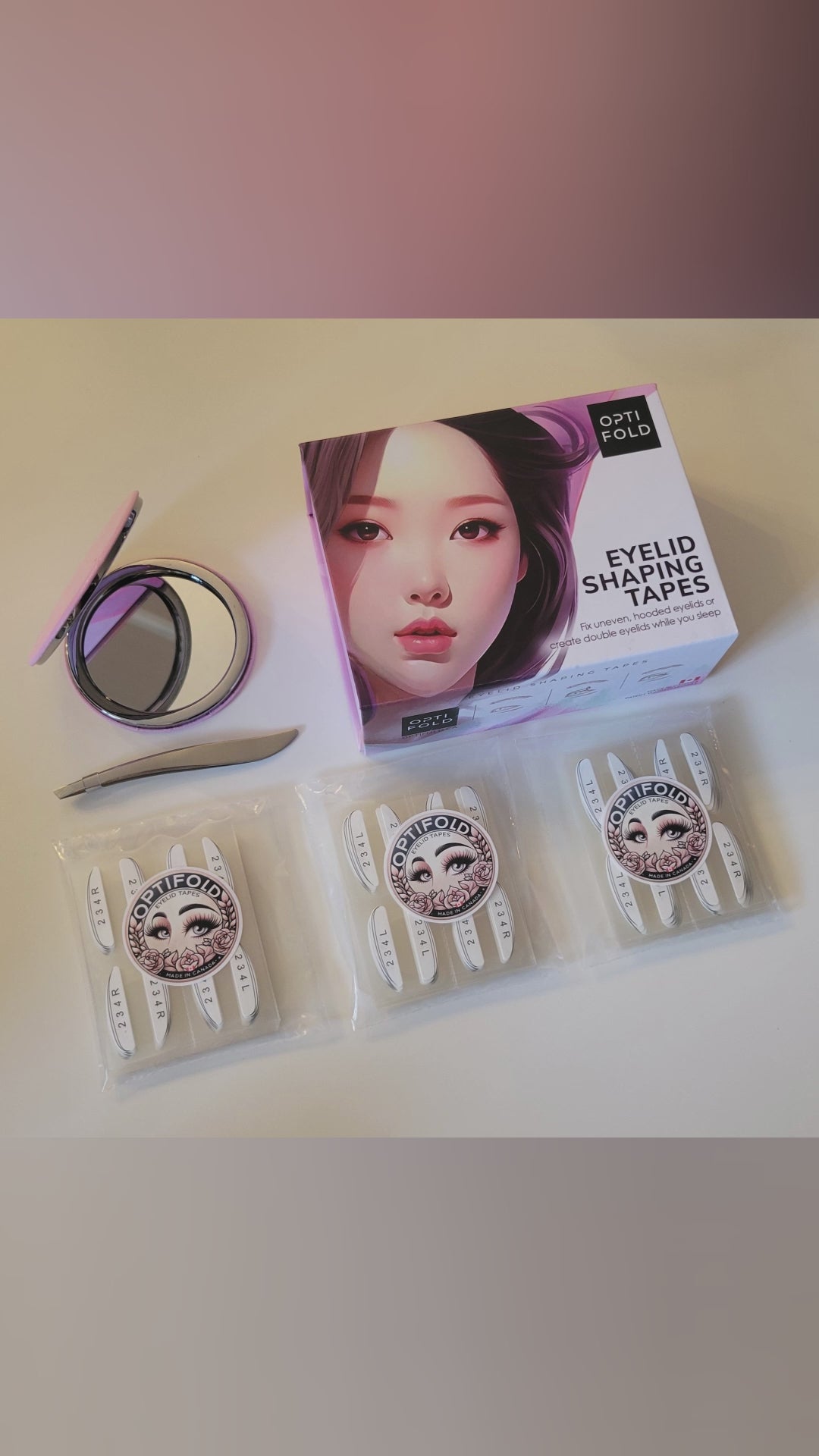


Optifold EyelidShaping™ Tapes (Standard Pack)
Optifold EyelidShaping™ Tapes (Standard Pack)
Couldn't load pickup availability
Create your desired eyelid crease with a simple nightly routine
Apply before bed, remove in the morning. This nightly routine introduces a controlled mechanical stimulus that helps your eyelids form and hold a more stable, defined crease over time.
- Night use only: apply before bed, then remove in the morning.
- Designed for uneven or hooded eyelids where one eyelid holds a crease more easily while the other tends to lose it.
- With consistent nightly use, results can progress from hours to days, then longer with light maintenance.
Start with the tapes, refine your placement, and build consistency over time. Additional guidance is always available if you want more precise calibration.

Helpful links
Start here if you're new. These guides walk you through placement, setup, and how to build consistency over time.
Explore what people are saying about Optifold

Everything you need to start with the tapes
This is the starting point for building a stable eyelid crease using the Optifold system. Begin with the tapes, learn the routine, and refine placement through consistency.
- Tape-based, non-surgical starting point
- Self-serve learning path with instructions and guide
- Optional check-in help later if you want placement feedback
Optifold tapes vs eyelid surgery
For many people, starting with a non-surgical, adjustable approach provides more control before committing to a permanent procedure.
| Optifold Tapes | Eyelid Surgery | |
|---|---|---|
| Starting point | Non-surgical and adjustable | Permanent procedure |
| Flexibility | You can refine placement and routine over time | Harder to adjust once done |
| Downtime | No surgery recovery period | Healing and recovery required |
| Risk of over-correction | Less invasive and easier to revise | Can be difficult to reverse if the result is not what you wanted |
| Who it suits | People who want a gradual, non-surgical path | People ready for surgery |
Not just for first-time non-surgical users
Even after surgery, eyelid structure can continue to change over time. Skin relaxes, symmetry can shift, and the crease may not always remain consistent.
Some people use Optifold as a non-surgical way to refine symmetry, support crease stability, and adapt to these changes without committing to another procedure.
📌 Getting started: first week basics
In the first week, small placement differences can significantly affect stability. Use a magnified tabletop mirror, keep your brows relaxed, and apply with your chin slightly up and eyes looking down.
Even a 1 to 2 mm adjustment can change how the crease holds. Early progress comes from finding the correct placement and angle for your eyelid.

📈 What to expect over time
Early improvement can appear within weeks, but the long-term goal is a more repeatable and stable crease path. Consistency matters more than any single application.

🧴 Does it cause sagging?
Only if you are using the wrong kind of tape.
Most cosmetic eyelid tapes and glue strips are too thin, too narrow, and pull the skin in the wrong direction. That can distort natural skin tension and create unstable folds over time.
Optifold was designed differently. Our tapes are shaped to better match eyelid profiles and support the fold in a more controlled way instead of forcing the skin unpredictably.
For a deeper breakdown of how tape design affects long-term eyelid behavior:
→ Why Eyelid Tape Can Make Skin Sag — When That’s True, and When It Isn’t


🧠 How the Optifold tape system works
Optifold works through directional mechanical force, not brute pressure. Each component plays a distinct role in guiding and stabilizing the crease path.

F-tape
The base layer. It helps distribute load and creates the surface where the fold can begin forming more predictably.

N-tape
The support layer. It adds focused compression to help guide and stabilize the crease path during normal blinking motion.

See the technical details


Get the results YOU want from our tapes